IROS 2026 Workshop: Enhancing Dexterous Manipulation Through Haptic Feedback
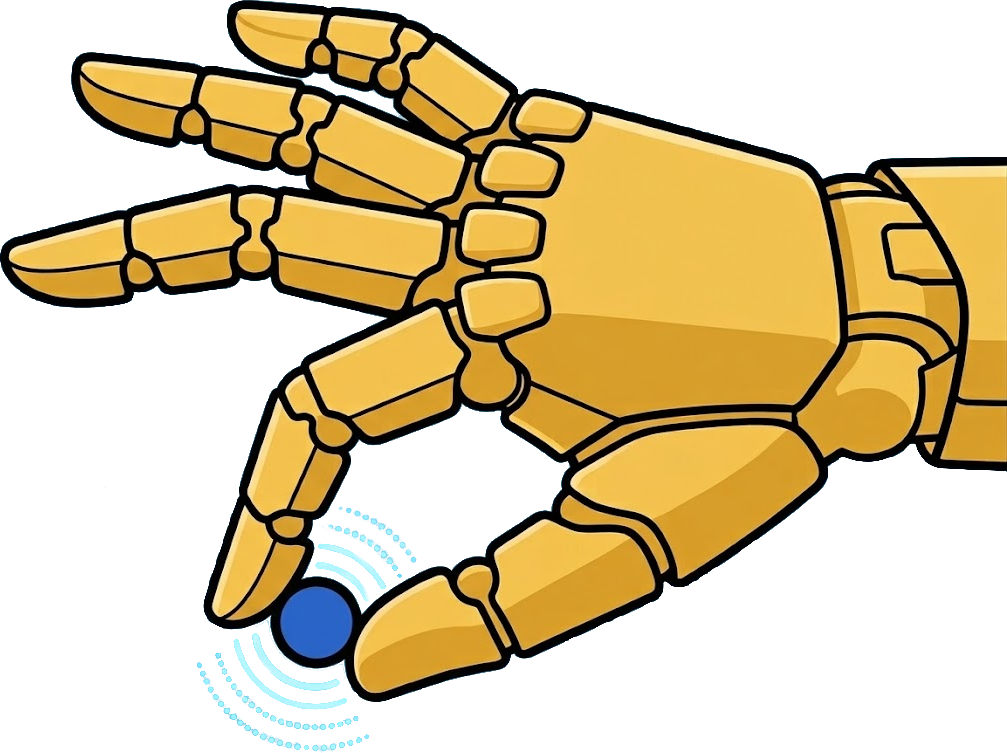
Enhancing Dexterous Manipulation Through Haptic Feedback
Bringing together tactile sensing, haptic interface design, contact modeling, and bio-inspired actuation to close the loop on robotic manipulation.
About the Workshop
Human manipulation relies fundamentally on rich tactile and kinesthetic feedback to regulate forces, adapt to contact conditions, and achieve fine motor control. Robotic manipulation, in contrast, still leans predominantly on vision and open-loop strategies — limiting robustness in contact-rich, uncertain environments. This workshop asks how recent progress in tactile sensing, haptic interfaces, and contact modeling can be integrated into modern manipulation frameworks, and brings together perspectives from robotics, haptics, human–robot interaction, and industry to promote a unified approach toward haptic-enabled dexterity.
Read the full motivationWorkshop Goals
Highlight recent advances in tactile sensing, haptic actuation, and interface design that measurably improve manipulation in robotic and human–machine systems.
Identify the technical challenges and research gaps in tactile sensing, contact modeling, and haptic rendering that currently cap manipulation performance.
Promote interdisciplinary dialogue among researchers working across robotics, haptics, tactile sensing, and human perception, whose efforts rarely meet in one room.
Discuss emerging application domains for haptic-enabled dexterity: teleoperation, advanced manufacturing, assistive robotics, and rehabilitation technologies.
Invited Speakers





Program at a Glance
Attending
The workshop is part of the IEEE/RSJ International Conference on Intelligent Robots and Systems (IROS 2026), held September 27 – October 1, 2026 in Pittsburgh. Attendance is open to all registered IROS participants; no separate workshop registration is required. Questions? Reach us at hapticsworkshop@gmail.com.