Adapting Physical Assistance, from Robotic Everyday Objects to 3D-Printed Haptic Experiences
Adapting Physical Assistance, from Robotic Everyday Objects to 3D-Printed Haptic Experiences
- Carnegie Mellon University
Abstract
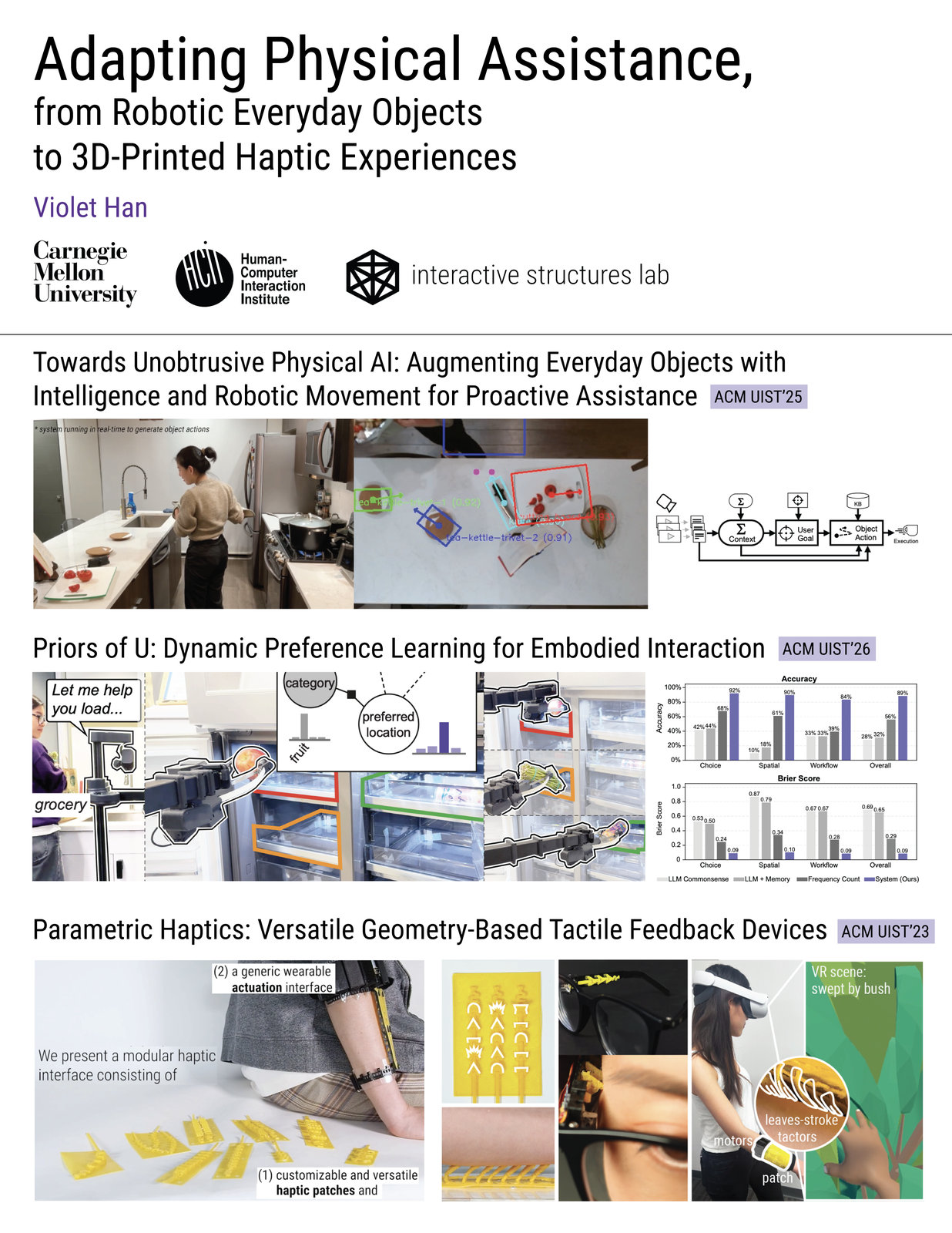
Robots are moving into everyday life to help people with daily tasks. In my research, I envision physical assistance that is embodied by the familiar objects already around us and personalized to each user. I also explore how such systems can communicate through touch, not only act, so help can reach us more directly. In Object Agents, we turn familiar passive objects into proactive collaborators that perceive a person’s activity, infer their goal, and move to assist. It is manipulation, just not with hands, an everyday object repositioning itself to help rather than an arm reaching for it. Our recent work on personalized assistance goes further, modeling how a given person wants a task done and using those preferences to decide how the system should act, so the same task is carried out differently for different people.
In Parametric Haptics, we develop geometry-based tactile patches that render many sensations from one conformable, wearable platform and embed into objects and wearables, so a system can communicate through touch as well as act.
Together, these ask how physical assistance can be versatile and personal rather than one-size-fits-all. I would welcome exchanging perspectives with the haptics and robotics community on physical assistance that adapts to each person and can take many forms, with different ways of helping.