Programmable Magnetic Micro-Cilia for Distributed Haptic Actuation
Programmable Magnetic Micro-Cilia for Distributed Haptic Actuation
- Carnegie Mellon University
Abstract
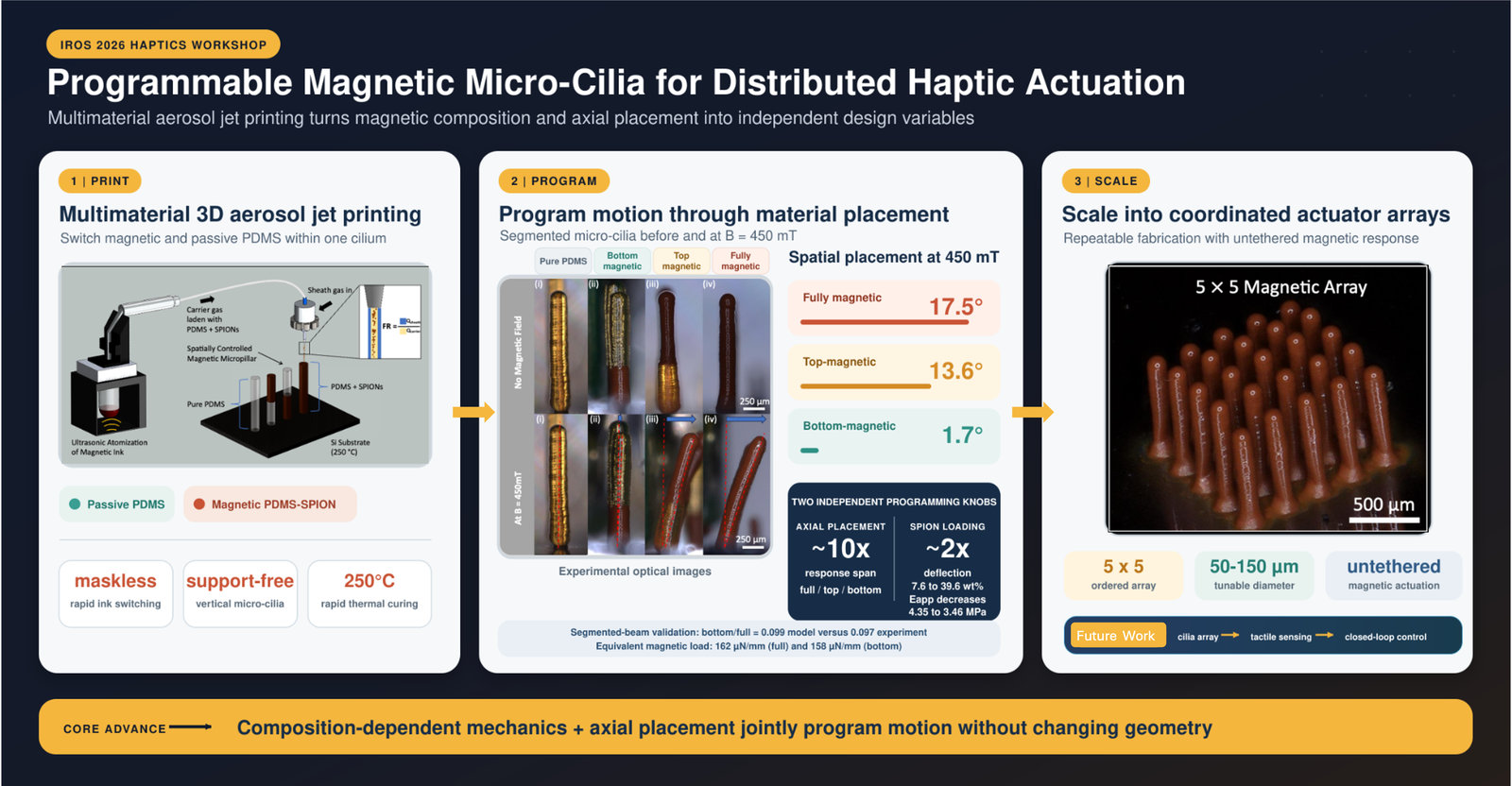
Distributed haptic interfaces require compliant actuator arrays with locally programmable responses. Conventional methods cannot readily place active and passive materials deterministically within microscale soft actuators. We present multimaterial three-dimensional aerosol jet printing (AJP) as a maskless, support-free route to spatially programmable magnetic polydimethylsiloxane (PDMS) micro-cilia. Switching magnetic and nonmagnetic PDMS along each cilium enables independent control of particle loading and axial placement within a single printed structure.
For homogeneous micro-cilia of fixed geometry, deflection increased with magnetic field and SPION loading. Raising SPION concentration from 7.6 to 39.6 wt% produced nearly twice the deflection at 450 mT. Mechanical characterization revealed a reduction in apparent Young’s modulus, from 4.35 ± 0.45 MPa at 7.6 wt% to 3.81 ± 0.20 MPa at 24.7 wt% and 3.46 ± 0.38 MPa at 39.6 wt%. Enhanced actuation therefore reflects coupled increases in magnetic response and mechanical compliance.
Spatial placement produced a larger programming range. At identical geometry and 39.6 wt% composition, fully magnetic, top-segment, and bottom-segment cilia deflected 17.5°, 13.6°, and 1.7°, respectively, at 450 mT. An Euler–Bernoulli segmented-cantilever model predicted a bottom/full normalized-deflection ratio of 0.099, closely matching the experimental ratio of 0.097. Using the measured 39.6 wt% modulus, full and bottom configurations independently mapped to equivalent distributed magnetic loads of 162 and 158 µN/mm. Their agreement supports common effective loading and attributes bottom-segment suppression primarily to force location. The top-segment response remains sensitive to elastic contrast and magnetic-field nonuniformity.
AJP also produced support-free inclined structures, diameter-tunable one-dimensional arrays, and ordered 5 × 5 arrays with coordinated magnetic response. Together, composition-dependent mechanics and spatial material placement provide complementary design variables for bio-inspired actuation. This platform supports future adaptive distributed haptic surfaces in which heterogeneous micro-cilia encode spatially varying mechanical responses under a common global magnetic stimulus, with tactile sensing and closed-loop control added subsequently.