Thermally Tunable, Magnetically Actuated Soft Haptic Unit Cell
Thermally Tunable, Magnetically Actuated Soft Haptic Unit Cell
- Carnegie Mellon University
Abstract
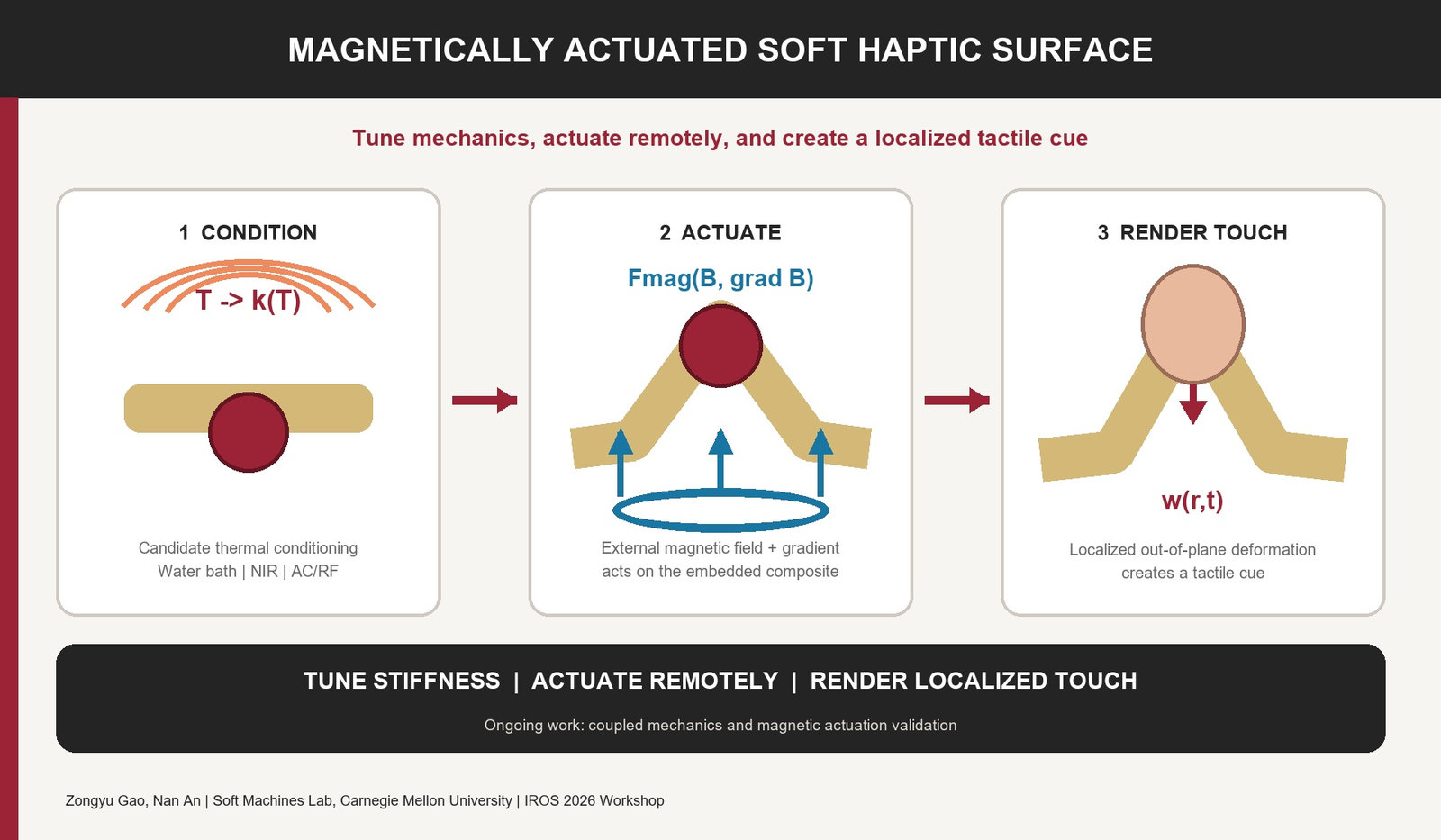
Compact soft haptic elements could provide localized tactile cues for wearable interfaces, teleoperation, and human-robot interaction. Producing appreciable deformation in a compliant, remotely controlled device remains challenging because the actuator must overcome the stiffness of its supporting structure. This work investigates a single soft haptic unit cell that combines a thermomechanically tunable polycaprolactone (PCL) structure with an embedded magnetized compliant composite. Conditioning the PCL near its transition region is intended to reduce its effective structural resistance, after which an external magnetic field and field gradient act on the embedded element to produce localized out-of-plane deformation.
The project separates mechanical-state conditioning from magnetic actuation so that the coupled physics can be evaluated systematically. A controlled water bath near 45 degrees C provides a candidate characterization baseline, while PDA-assisted near-infrared photothermal heating, AC electromagnetic or induction-type heating, and RF heating are being considered as possible integrated conditioning methods. The working framework connects conditioning input, temperature-dependent mechanics, magnetic field and gradient, magnetic force, and displacement. These relationships will be identified through calibration and experiment.
Current work focuses on an individual unit cell. Planned validation includes specimen geometry and material properties, known-force mechanical calibration, magnetic field and gradient mapping, force-displacement response, transient behavior, hysteresis, recovery, and cycling. The unit cell serves as a test platform for characterizing coupled thermal, magnetic, and mechanical behavior and may provide a foundation for future multi-element haptic interfaces.
Keywords: soft haptics; haptic unit cell; magnetic actuation; thermally tunable mechanics; human-robot interaction