Investigating the Functional Roles of Fingers Involved in a Dexterous Manipulation Task
Investigating the Functional Roles of Fingers Involved in a Dexterous Manipulation Task
- Texas A&M University
Abstract
Everyday tasks like opening a jar or turning a doorknob demand precise coordination between digits, yet it remains unclear whether individual fingers adopt distinct, consistent functional roles during dynamic manipulation, and how these roles scale with task difficulty. Studies using five-digit grasps have characterized digit-level force and torque contributions during jar-opening-like tasks, but the inherent redundancy of a five-finger grasp, where digit forces are known to co-vary in both direction and magnitude, can obscure the individual, functional contribution of each finger.
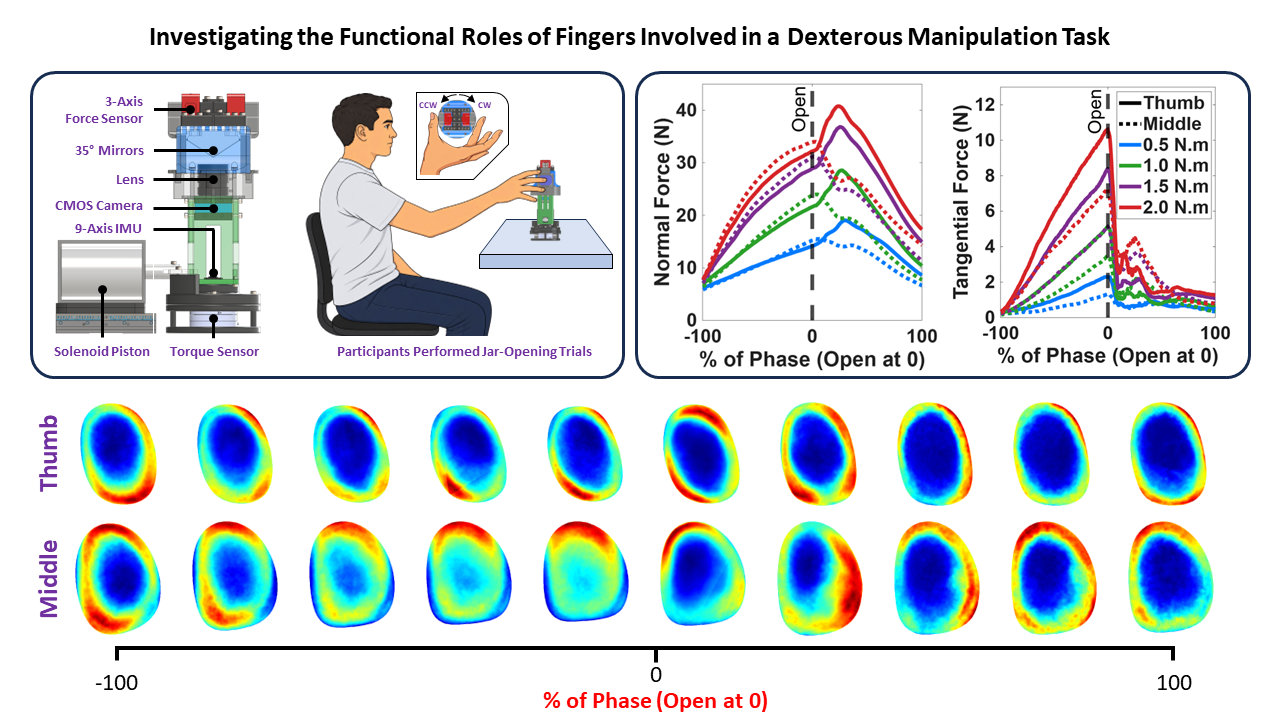
To isolate digit-specific behavior, we developed an instrumented, jar-like apparatus grasped using a constrained thumb–middle finger pinch. This constrained, two-digit grasp reduces the redundancy inherent to full-hand grasps, enabling a clearer examination of how each digit individually contributes to force and torque production. The platform integrates 3-axis force sensors at each fingerpad contact site, a torque sensor paired with a solenoid-triggered piston to simulate the sudden opening of a jar, an IMU to track rotation, and a dual-mirror camera system enabling simultaneous imaging of both fingerpads via frustrated total internal reflection (FTIR).
Participants performed jar-opening trials across four opening threshold torques to examine how force-sharing between the thumb and middle finger emerges, scales with difficulty, and relates to fingerpad skin deformation and slip-related cues extracted via optical flow tracking.
This work aims to determine whether the central nervous system assigns consistent functional roles to individual digits during dexterous manipulation, and how cutaneous sensory feedback shapes digit-level force coordination, with implications for hand rehabilitation, prosthetic control, and the design of dexterous robotic grippers.