A Fingertip Haptic Device for Rendering Directional Motion Cues
A Fingertip Haptic Device for Rendering Directional Motion Cues
- Carnegie Mellon University
Abstract
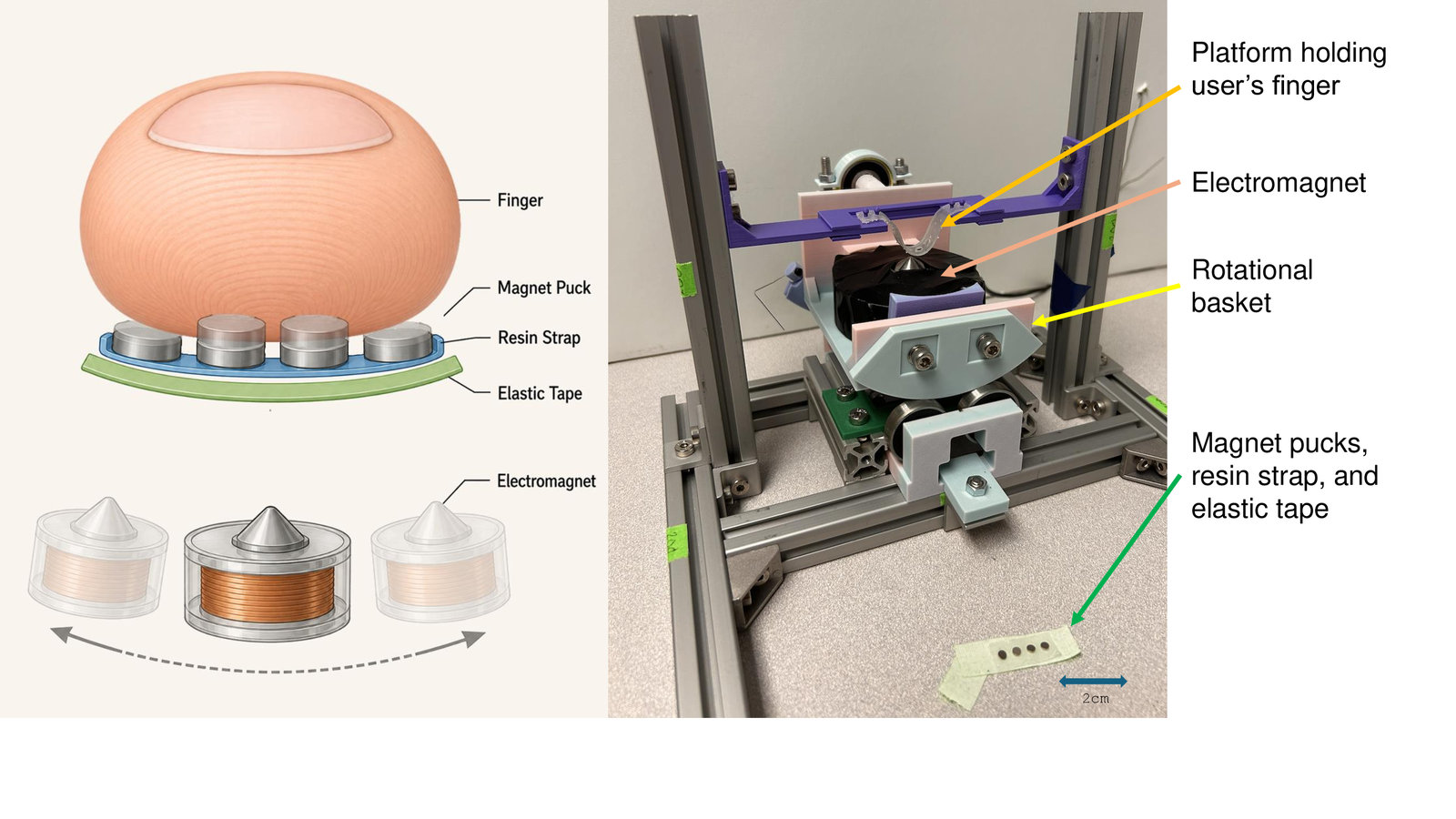
Dexterous manipulation relies on accurate motion-direction information to coordinate finger movements and correct manipulation errors. In this study, we present a haptic device that renders directional tactile cues at the fingertip. The device moves an electromagnet along a fixed arc beneath the fingertip and modulates its magnetic field intensity as a function of position to generate varying normal forces on a finger-worn array of magnetic pucks. The magnetic interaction produces coordinated millimeter-scale normal displacements of the pucks toward the fingertip, creating the perception of tactile motion across the skin. The direction and speed of the tactile stimulus are controlled through the electromagnet’s motion and magnetic actuation profile. These profiles include the generation of sinusoidal and square wave shaped stimuli that generate a traveling normal indentation across the fingertip. To evaluate whether the rendered tactile cues conveyed motion direction, we conducted a two-alternative forced-choice (2AFC) study in which participants were asked to identify the perceived sliding direction (left or right) across different actuation speeds and magnetic actuation profiles. Initial results from the study show that participants were able to identify the direction of motion reliably.